A Natural Approach to Better Health
Chiropractic is a natural, non-invasive approach to health care that focuses on the relationship between the spine, nervous system, and overall function of the body.
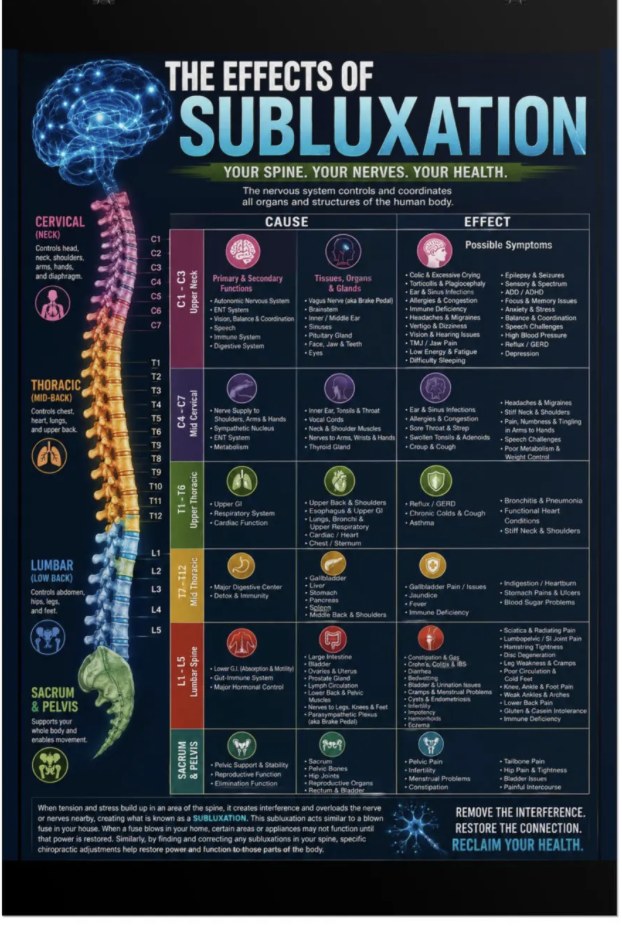
Your brain and spinal cord make up the central nervous system—the body's primary communication network. Spinal nerves branch from the spinal cord and communicate with the rest of the body, influencing movement, sensation, and function.
Because the spine protects the spinal cord and works closely with the nerves, muscles, and joints, healthy spinal movement and function are an important part of overall well-being.
What Does a Chiropractor Do?
Doctors of Chiropractic (DCs) complete extensive doctoral-level education, typically requiring a minimum of 7–8 years of higher education and medical professional training.
In addition, chiropractors receive specialized training in the spine, nervous system, musculoskeletal system, and chiropractic adjusting techniques.
Doctors of Chiropractic also complete extensive clinical training and must pass national and state licensing examinations. This education prepares them to evaluate patients, recognize conditions that may require referral to another healthcare provider, and provide safe, individualized chiropractic care.
It's About More Than Pain
Many people first seek chiropractic care because of back pain, neck pain, headaches, or an injury. But chiropractic care is about more than simply treating where it hurts.
The spine, nerves, muscles, and joints are interconnected. Sometimes, the area where you experience pain isn't the area where the underlying dysfunction began.
Chiropractic looks at how these systems are working together to identify areas of restricted movement or dysfunction that may be contributing to pain and reduced function.
Looking Beyond the Symptoms
Rather than focusing only on temporary symptom relief, chiropractic seeks to understand why the problem is occurring in the first place.
By identifying areas of joint restriction and impaired movement, chiropractic care aims to restore healthier movement and function—addressing the underlying mechanical dysfunction rather than simply masking the symptom.
A Simple Way to Understand Chiropractic
Think about the electrical system in your home.
Imagine a light controlled by a dimmer switch. If the dimmer is turned down, you could replace the light bulb with the most powerful bulb available, but the light would still remain dim.
The bulb isn't necessarily the problem.
The first step is identifying what is preventing the system from functioning properly.
The body can be viewed in a similar way.
Getting to the Root of the Problem
Chiropractic looks beyond the symptom to understand what may be contributing to the problem.
Rather than simply chasing pain from one area to another, the goal is to identify areas of dysfunction, address restricted movement, and help the body move and function more effectively.
The Goal: Better Movement. Better Function. Better Health.
Chiropractic care is about more than where it hurts.
It's about understanding how the body is connected, identifying what isn't functioning properly, and creating a personalized approach to help restore movement and function.
When the body moves better, it can function better.